Research · Portfolio Insights
Enterprise Intelligence, AI, and Knowledge — one integrated portfolio.
Organizations don't suffer from a lack of information. They suffer from a lack of execution. This portfolio brings together the disciplines that turn information into knowledge, knowledge into intelligence, and intelligence into action.
Foundations · Enterprise Intelligence
The building blocks
Organizational Memory
Codifying the institutional knowledge that walks out the door every day.
Enterprise Intelligence
Synthesizing distributed information into actionable insight at scale.
Knowledge Architecture
Structuring information so people and systems can find, trust, and use it.
Intelligent Retrieval
Semantic search, RAG, and agentic retrieval grounded in enterprise context.
AI Readiness
Data, governance, and operating models that make AI investments productive.
Decision Acceleration
Reducing time-to-decision by closing the loop between data, knowledge, and action.
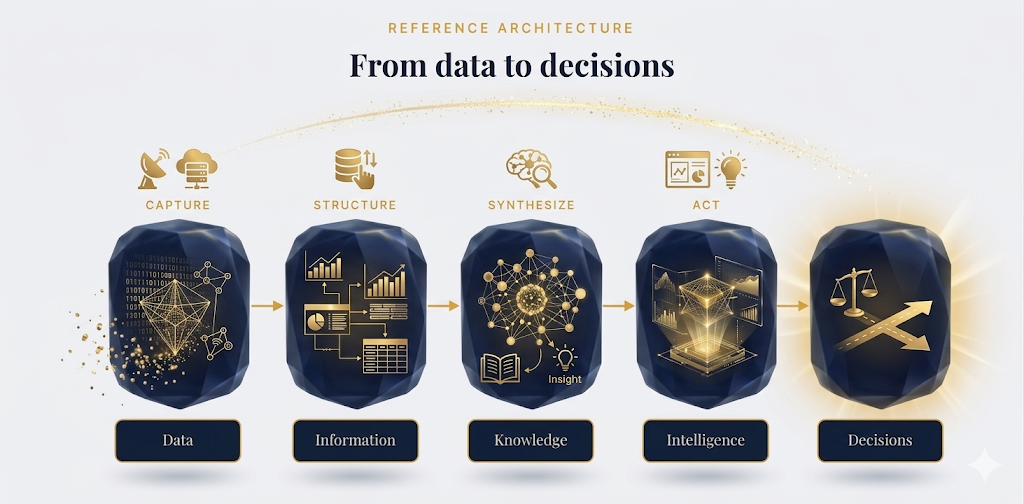
Reference Architecture
From data to decisions
AI & Knowledge Management
Knowledge management for the age of AI
AI improves existing systems. It rarely fixes broken ones. The organizations that win with AI are the ones that get their knowledge architecture, governance, and operating model right first.
Knowledge Architecture
Taxonomies, ontologies, and metadata models that make enterprise knowledge addressable.
Governance Models
Roles, policies, and lifecycle controls that keep knowledge trusted and current.
Agentic AI
Designing and deploying agents that act on enterprise knowledge with accountability.
AI Readiness
Assessing data, content, governance, and operating model maturity for AI scale.
Enterprise Search
Semantic and retrieval-augmented search across structured and unstructured estates.
Content Intelligence
Turning documents, transcripts, and tickets into structured organizational signal.
Knowledge Operations
The KM operating model: people, process, platform, and performance metrics.
Organizational Memory
Capturing decisions, rationale, and learning so the enterprise compounds knowledge.
Operating Model
Enterprise Intelligence Operating Model™
Four Layers. One System.
High-performing organizations do not execute because they have better people, better technology, or better processes alone.
They execute because these capabilities operate as an integrated system. The Enterprise Intelligence Operating Model™ aligns people, knowledge, technology, governance, and measurement into a continuous execution engine that transforms information into organizational performance.
People
People · Roles · Culture
Execution begins with people. Technology cannot compensate for unclear ownership, fragmented accountability, or cultures that discourage learning. This layer establishes the human operating system that enables organizational intelligence.
Key Capabilities
- · Leadership alignment and strategic clarity
- · Role definition and accountability
- · Knowledge-sharing behaviors
- · Change adoption and readiness
- · Learning culture development
- · Communities of practice
- · Workforce capability development
- · Human-centered AI adoption
Core Question
Do our people understand what matters, who owns it, and how to contribute?
Desired Outcome
A workforce capable of creating, sharing, applying, and continuously improving organizational knowledge.
Process
Process · Governance · Lifecycle
Knowledge becomes valuable when it is governed, maintained, and integrated into how work gets done. This layer creates the structure that transforms information into trusted organizational assets.
Key Capabilities
- · Knowledge governance
- · Content lifecycle management
- · Authoritative source management
- · Operating procedures
- · Taxonomy and metadata standards
- · AI readiness assessments
- · Risk and compliance controls
- · Federated governance models
Core Question
Can knowledge be consistently created, maintained, trusted, and reused?
Desired Outcome
Reliable and scalable knowledge operations that support enterprise execution.
Platform
Platform · Architecture · AI
Technology serves as the nervous system of the enterprise. The objective is not more tools. The objective is intelligent access, retrieval, automation, and decision support.
Key Capabilities
- · Knowledge platforms
- · Enterprise search
- · Intelligent retrieval systems
- · Agentic AI
- · Organizational memory systems
- · Content intelligence
- · Data architecture
- · AI-enabled workflows
- · Knowledge graph design
Core Question
Can people and AI access the right knowledge at the right moment?
Desired Outcome
A connected enterprise intelligence ecosystem that accelerates decision-making and execution.
Performance
Performance · Metrics · Learning
Execution without measurement is activity. Measurement without learning is reporting. This layer ensures that organizational intelligence translates into business outcomes.
Key Capabilities
- · Adoption analytics
- · Content effectiveness measurement
- · AI utilization metrics
- · Operational performance indicators
- · Knowledge health scores
- · Decision velocity metrics
- · Continuous improvement loops
- · Organizational learning systems
Core Question
How do we know our knowledge ecosystem is creating business value?
Desired Outcome
A continuously improving system that converts intelligence into measurable performance.
How the Layers Work Together
People create and consume knowledge.
Process governs and operationalizes knowledge.
Platforms scale and accelerate knowledge.
Performance measures and improves knowledge.
Together, these layers create an Enterprise Intelligence Engine capable of transforming:
This is how organizations build sustainable competitive advantage in the age of AI.
Operating Philosophy
Steven's Execution Principles
These principles define how I operate, how I lead transformation, and how I help organizations move from complexity to execution. They are not motivational statements. They are practical operating rules forged through building systems, leading change, and solving enterprise-scale problems.
01
Execution Beats Intention
Ideas have no value until they create outcomes. Strategies, roadmaps, and plans matter only when they translate into measurable action. Progress is earned through disciplined execution, not aspiration.
Operating Belief
The market rewards results, not intentions.
02
Merit Compounds Through Action
Capability grows through consistent application. The individuals and organizations that create the greatest impact are not necessarily the most talented—they are the most disciplined in turning knowledge into action over time.
Operating Belief
Small wins, repeated consistently, create exponential advantage.
03
Knowledge Must Flow to Create Value
Knowledge trapped in documents, departments, or individuals creates friction. Knowledge creates value only when it moves to the people, processes, and systems that need it. The goal is not knowledge accumulation. The goal is knowledge utilization.
Operating Belief
The speed of knowledge flow determines the speed of organizational execution.
04
AI Amplifies Existing Systems
AI does not fix broken organizations. It accelerates whatever already exists—good or bad. Strong governance, quality knowledge, clear processes, and accountable teams become force multipliers. Weak foundations become amplified liabilities.
Operating Belief
AI is an amplifier, not a substitute for operational excellence.
05
Leadership Creates Clarity
Confusion is one of the greatest barriers to execution. Leaders exist to create alignment around priorities, decisions, ownership, and outcomes. When people understand what matters and why it matters, execution accelerates.
Operating Belief
Clarity reduces friction and increases organizational velocity.
06
Remove the Limiting Factor First
Every system has a constraint. Improvement efforts fail when organizations optimize around the bottleneck instead of addressing it directly. Sustainable progress comes from identifying and removing the factor that most limits performance.
Operating Belief
The fastest path to improvement is through the constraint.
07
Build Capabilities, Not One-Time Solutions
Temporary fixes create recurring problems. The objective is to build repeatable capabilities that continue generating value long after a project ends. Strong organizations invest in systems, practices, and competencies that scale.
Operating Belief
Capability creation outperforms dependency creation.
08
Learning Is the Ultimate Competitive Advantage
Markets change. Technology evolves. Strategies expire. The organizations that endure are those that learn faster than their environment changes. Learning transforms experience into intelligence and intelligence into adaptation.
Operating Belief
The ability to learn, adapt, and improve is the foundation of long-term success.
09
Systems Drive Outcomes
Individual effort matters, but systems determine consistency. When outcomes depend on heroics, performance remains fragile. When outcomes are embedded into processes, governance, technology, and culture, performance becomes scalable.
Operating Belief
Sustainable excellence is designed, not improvised.
10
Measure What Matters
What gets measured influences behavior. Metrics should illuminate progress, reveal constraints, and guide decision-making. Measurement is not about reporting activity—it is about improving outcomes.
Operating Belief
Data should drive learning, not bureaucracy.
11
Simplicity Scales
Complexity creates friction. The most effective operating models, governance structures, and knowledge systems are often the simplest. Simplicity improves adoption, accelerates decisions, and increases resilience.
Operating Belief
If people cannot understand it, they cannot execute it.
12
Continuous Improvement Is a Discipline
There is no finish line for organizational excellence. Every process, system, and capability can be improved. High-performing organizations institutionalize reflection, feedback, and adaptation as part of daily operations.
Operating Belief
Improvement is not an initiative—it is an operating habit.
Together, these principles shape how organizations transform information into intelligence, intelligence into action, and action into measurable performance. They are the foundation beneath every engagement, every framework, and every Enterprise Intelligence Operating Model™ implementation.
This is how sustainable execution is built. This is how organizations create lasting advantage.

Built With Teams
Intelligence is a team sport.
The architecture matters. The people matter more. Enterprise intelligence becomes real when leaders, operators, and engineers share a common rhythm — and celebrate the wins that prove the system is working.